
New Labour are seriously problematic when it comes to openess and real transparency. They've hated it and have created sets of well networked information kevlar-ed dominion bureaucracies which includes big and small charity players.
Despite the post Mid Staffs (400 extra deaths) surge of Alan Johnsons speech about open Boards which have public meetings at Foundation Trusts - very little reform has happened. The admin classes are stiking back behind the scenes taking advice from each other and seeking to interupt the flow of critique at the services . Which is them really..
Dominion is all with these people - the right to manage secretly cannot be part of a health giving democracy apart from patient confidentiality . Openess creates the need for political debate and social and policy changes, and information denying practices on patient consultation rights over changed services and minutes of committees is basically the trend toward State and admin-class fascism disguised.
So get your UK Eagles to brush up on FOIA Guidance clauses - and expect a very difficult quarry indeed.
Links to guidance are provided here (copied from the Information Commisioners Office site ) :
The freedom of information guidance we produce is split into these four categories:
- Procedural guidance - this deals with the practical aspects of the Freedom of Information Act, such as how to use the Codes of Practice. This section also includes good practice guidance.
- Topic specific guidance - this guidance is designed to assist authorities in dealing with requests for specific types of information, such as information relating to the deceased.
- Sector specific guidance - this is guidance aimed at a particular public authority sector.
- Exemptions guidance - this deals with the exemptions under the Act.
Guidance on the model publication scheme can be found in the model publication scheme section of the website. Although some of the guidance on this page also covers Environmental Information Regulations (EIR), specific guidance can be found in the EIR section of the website.
Updates:
Applying the exemption for third party personal data: the Tribunal’s approach in House of Commons v IC & Leapman, Brooke and Thomas
(Other recently updated guidance is labelled below)
Procedural guidance
When is information caught by the Freedom of Information Act? (AG12)
Lifecycle of a request (GPG3)
Consideration of requests without reference to the identity of the applicant or the reasons for the request (GPG6)
Interpreting a request
Information held: retrieving and compiling information from original sources
Information held on behalf of another - new
Making a request for information – new
Section 8 - Valid request – name and address for correspondence
Section 9 - Charging a fee
Section 9,12,13 – Using the Fees Regulations
Section 10 - Time for compliance (AG11)
Section 11 - Means of communication (AG29)
Section 12 - Redacting and extracting information
Section 14 – Vexatious requests – a short guide
Section 14 - Vexatious or repeated requests (AG22) – recently updated 03/12/08
Section 16 - Advice and assistance (AG23) – recently updated 1/07/09
Section 16 - Good practice in providing advice and assistance
Section 17 - Refusing a request – new
Section 17 - Writing a refusal notice – new
Section 17 - Time limits on considering the public interest (GPG4)
Codes of Practice - Using the procedural codes of practice (GPG2)
Codes of Practice - Records management FAQs (AG8)
Codes of Practice – Internal reviews
Codes of Practice - Time limits on carrying out internal reviews (GPG5)
Codes of Practice - Destruction of requested information
Topic specific guidance
Enterprise Act 2002 and Freedom of Information Act 2000 - new
Reports provided by third parties - new
Circular (or round robin) requests- new
Information contained in court transcripts
Access to information about public authorities’ employees
Access to information about the deceased
What should be published: minutes and agendas
When should salaries be disclosed?
When should names be disclosed?
Complaints and investigations files – how to approach them
Guidance on dealing with requests for MP’s correspondence relating to constituents
Sector specific guidance
Information produced or received by councillors - new
Basic guide on compliance for first tier councils
Exemptions guidance
Duty to confirm or deny (AG21)
Prejudice and adversely affect (AG20)
Public interest test (AG3) – recently updated 1/7/09
The exemptions
Section 21 - Information reasonably accessible to the applicant by other means (AG6)
Section 22 - Information intended for future publication (AG7)
Section 23 - Information supplied by or relating to security bodies - new
Section 24 - The national security exemption – new
Section 26 - Defence (AG10)
Section 27 - International relations (AG14)
Section 28 - Relations within the UK (AG13)
Section 29 - Economy (AG15)
Section 30 - Investigations (AG16) – recently updated 03/08/09
Section 31 - Law enforcement (AG17) – recently updated 03/08/09
Section 32 - Information contained in court records (AG9)
Section 33 - Public audit (AG18)
Section 34 - Parliamentary privilege – under review
Section 35 - Policy formulation, Ministerial communications, Law Officers’ advice and the operation of Ministerial Private Office (AG24)
Section 36 - Effective conduct of public affairs (AG25)
Section 37 - Communications with Her Majesty and the awarding of honours (AG26)
Section 38 - Health and safety (AG19)
Section 39 - Environmental information (EIR guidance pages)
Section 40 - Personal Information (AG1) – recently updated 11/11/08
Section 40 - Update note: Applying the exemption for third party personal data: the Tribunal’s approach in House of Commons v IC & Leapman, Brooke and Thomas
Section 41 - Information provided in confidence (AG2)
Section 41 - The duty of confidence and the public interest
Section 41 - Information provided in confidence relating to contracts
Section 42 - Legal professional privilege (AG4) – recently updated 11/11/08
Section 43 - Commercial interest (AG5)
Section 43 - Public sector contracts –
Section 43 - Commercial detriment of third parties
Section 44 - Prohibitions on disclosure (AG27)








Lord Brett
Silvis Rivers ! Your 1% per cent disagreement figure here !
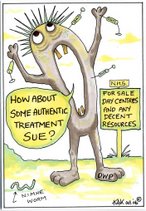
There's a sketch of a mental health User colleague - Yep - a neck bolted cogbottery success story
SEE HERE : So seee I have an evidence base Lord Brett
However , Welfare and Reform, and CBT supply eh ? .. Oh yes, many do know they are all woven policies
The supply sides of therapy up and down the country available through PCT's , Trusts and GP surgeries are coming on stream with the £173 million of Govt funding over several years.
The Govt took it upon themselves to push CBT – it was endorsed of course as part of the welfare to work reforms by Dick Layard (LSE) to get people back to work and some very simplistic things were claimed of it like 10 – 12 sessions would see many thousands go back to work as CBT successes.
I believe this approach was flawed at many levels both therapeutic and at the recognition of individualised need for therapy help and personal pace. Personalised services were the kinds of things we were promised which have been overtaken by large planning and system delivery gurus ..
There was plenty of supply sides (unharnessed) for therapies already in the private sector and if MH patients had had a patient choice culture through say local purchasing (GP level) then slowly a culture of decent therapies would have taken root and the useless practitioners would have been weeded out by patient satisfaction being measured at a local level ..
There's no competition with the State so the State cannot claim a Patient Choice culture and in mental health as I say we were promised Patient Choice and better personalised budgets for recovery and we've seen bagger all that cuts the mustard, and now we are getting welfare deformed-reform oppression
The Mild to Moderate depressive category of those out of work who were going to be the first candidates of CBT is another example the strange language of system driven welfare reform bureacracy . People with depression present differently with different reasons for being depressed and many (excluding Bipolar) have years of compressed misery and likely or not special events they need to emotionally alleiviate and resolve ..
CBT as its promoted is simplistic and its going to be played with by graduate-workers employed by the NHS… That is wrong …
After 36 years of seeing mental health suffering of all varieties I can honestly say I think that's a mistake and there are plenty of skilled practitioners out their in the market place where Patient's could get a real choice to find ways to resolve their pain , depression and misery .. The money was there in 2004 but the Govt saw fit to create NIMHE (now defunct) which went on to spend in excess of £100 million. I see that as a major loss of treatment opportunity for people who needed therapy choices years ago .. The market was left untapped and even alienated by the insistence it come under Govt control through the Health Professions Council despite bodies like UKCP and BACP and others having adequate ethical comittees and complaint processes.
CBT is not Patient Choice - its being used for State dominion - Neither in my opinion is it a depth approach to resolve difficult emotional pains and states by actually feeling them towards resolution and integration, which is an emotionally realistic way to deal with most of the human condition.
Its a lightweight application with limited scope and I think many MH patients and people in the community will be shortchanged by it - if its allied to deeper emotional approaches and acceptances of peoples feelings, and feeling states towards resolution, then maybe it will become useful because then it creates a place for recognition of feelings - proportionality of reaction, and past and present and how one can serve to whip up reactions in the other .
I do hope you like my evidence base ..
Silvis Rivers
USERWATCH & COGBOTTERY EVIDENCE BASE
LORD BRETT :
Silvisrivers
yes I like your `evidence-base`. It made me smile and that is always welcome in my book.
I share your scepticism at the new use of CBT and the almost factory-style production of `fast-track` IAPT practitioners who will be as limited in their ability in all likelihood as their rushed training implies.
However, those of us who trained a while ago and took many years to do it, including starting with a nursing qualification and many years of experience in that field too might feel slightly irritated that because CBT has been co-opted by NuLab, many people including sad to say, your good self view it as lightweight and trivial as the politicians who seem to push its use.
This view of CBT as not addressing `real issues` and a `quick fix` simply reveals a lack of knowledge of the subject and is in a sense, as lightweight, uninformed and thin a dismissal as the behaviour of those you claim to despise.
SILVIS RIVERS :
Lord Brett
Hey if you feel you are adequate fine ... I have not personalised this issue - and your sadness is noted but so is the pain of others in my community of mental health Users that are shortchanged by system top down thinking and would be welfare reform applications
Welfare Reform and the top down way its being planned included CBT jackboots too or maybe they should be called "Dick-boots" after a certain person who is economical with therapy .
Personalisation of services has gone out of the NHS window and welfare reform has become the new psycho-work-alot religion . Even Job Centre staff hover in and and around NHS mental health Trusts.. Its intimidating and upsetting people . Some of us are so affected by the assault of the planning gurus that we do wonder if death is better . Now that's being hurt .
But on therapy there should have crucially been choices not just one favoured application (CBT) and all the training money to my mind gone to it is wasted when its obvious we could have enjoyed monitored patient choices years ago using available local supply sides . God knows some of us could have grown into more functionality .
The whole point for me and others in the User-community was to believe in a patient recovery led by choices and incremental growth . Its what we were all promised . I've seen CBT used by "practitioners" in the NHS where they expect the patient to do"homework" to identify negatively co-reinforcing thought and feeling patterns and the poor boggers have been lost .
I've talked to these people and discovered so many are seriously wounded people from life and they need deeper more empathically providing applications
After your post I have taken a decision to ask USERWATCH to make an exception against CBT slagging off and therefore you have been offered a Dogology .. Now this is rare
I'd swipe a copy of it quick ..
SEE HERE A special dogology to Lord Brett ..
Seeeeee now I do have the power of magical smiling and wickedish therapy which makes Lords laugh ..
Silvis Rivers
USERWATCH