.

Yep its some GP out on the edges in Birmingham as the NHS empire reshapes.
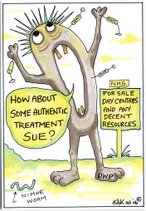
It seems some slick movements by the South Bham PCT and others in B'ham contravenes the Patient Choice agenda quite seriously according to the Co-operation and Competition Panel take a look below . Mind you in mental health "choice" is highly likely to be stitched up with 3rd Sectorisation and the cheap as chips volunteering-economy ..
What will the difference between slavery in the future and volunteering ? Volunteering is done without chains and whips, but god knows how all these volunteers will be supported when the welfare state and benefits are unlikely to support their needs in an economy of illusions. Yet this development with other parts of health is interesting - who knows maybe in time the new Charity-State in mental health provision will be honest and become businesses. We advise that you stop being suckers though and just stop doing the lottery. Save your money for your locality not the newly re-adjusting middle classes .
What will the difference between slavery in the future and volunteering ? Volunteering is done without chains and whips, but god knows how all these volunteers will be supported when the welfare state and benefits are unlikely to support their needs in an economy of illusions. Yet this development with other parts of health is interesting - who knows maybe in time the new Charity-State in mental health provision will be honest and become businesses. We advise that you stop being suckers though and just stop doing the lottery. Save your money for your locality not the newly re-adjusting middle classes .
SEE THE DOCUMENT ABOUT BHAM PCT'S
Extract below from the Co-operation and Competition Panel
" EXECUTIVE SUMMARY Feb 2011
1. The Cooperation and Competition Panel (CCP) has reviewed the proposed merger of the community services provider arms of South Birmingham PCT, Birmingham East and North PCT and Heart of Birmingham PCT. Our advice to the Department of Health is that the merger as currently constituted is not consistent with Principles 9 and 10 of the Principles and Rules for Cooperation and Competition (Principles and Rules).
2. The CCP concluded that the merger between the three PCT provider arms in Birmingham will reduce patient choice and competition and thus give rise to material costs to patients and taxpayers in relation to the provision of: District nursing and Health visiting services across the three PCTs in Birmingham; and Universal children’s services in Birmingham East and North PCT and South Birmingham PCT.
3. The CCP also concluded that the vertical integration of the acute elective dental services provided by the provider arm of South Birmingham PCT with the community dental services provided by the provider arm of Heart of Birmingham PCT, a provider of community services that holds gate-keeping responsibilities equivalent to those of a GP, is likely to undermine the GP gatekeeper function and hence give rise to costs to patients.
4. Together with this report, the CCP is publishing for consultation with interested stakeholders an invitation to comment on suitable remedies to address the adverse effect on patient and taxpayers identified in this report. Comments on this notice should be provided by 4 March 2011 and we plan to publish our remedies recommendations in March 2011. "
AND BELOW FROM HEALTH SERVICE JOURNAL March 10th 2011
"The Cooperation and Competition Panel has ruled outright against a merger between two trusts for the first time.
2. The CCP concluded that the merger between the three PCT provider arms in Birmingham will reduce patient choice and competition and thus give rise to material costs to patients and taxpayers in relation to the provision of: District nursing and Health
 visiting services across the three PCTs in Birmingham; and Universal children’s services in Birmingham East and North PCT and South Birmingham PCT.
3. The CCP also concluded that the vertical integration of the acute elective dental services provided by the provider arm of South Birmingham PCT with the community dental services provided by the provider arm of Heart of Birmingham PCT, a provider of community services that holds gate-keeping responsibilities equivalent to those of a GP, is likely to undermine the GP gatekeeper function and hence give rise to costs to patients.
4. Together with this report, the CCP is publishing for consultation with interested stakeholders an invitation to comment on suitable remedies to address the adverse effect on patient and taxpayers identified in this report. Comments on this notice should be provided by 4 March 2011 and we plan to publish our remedies recommendations in March 2011. "
AND BELOW FROM HEALTH SERVICE JOURNAL March 10th 2011
"The Cooperation and Competition Panel has ruled outright against a merger between two trusts for the first time.
Norfolk and Waveney Mental Health Foundation Trust had wanted to merge with Suffolk Mental Health Partnership Trust.
The move would also have allowed Suffolk to achieve foundation status as part of the merged organisation.
But the panel said the merger would result in the removal of “close competition” for contracts from three primary care trusts, due to the lack of other credible competitors within the area.
Any benefits accruing from the merger were too small to outweigh the adverse effect from the reduced competition, the panel said."


.jpg)